RHS News

2026 Global History Lecture, with the German Historical Institute, London

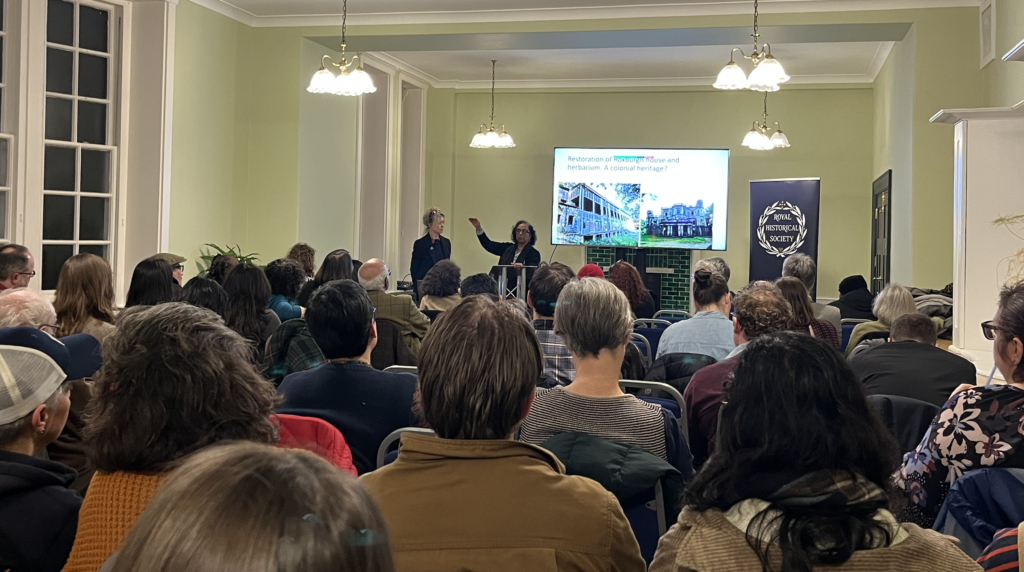
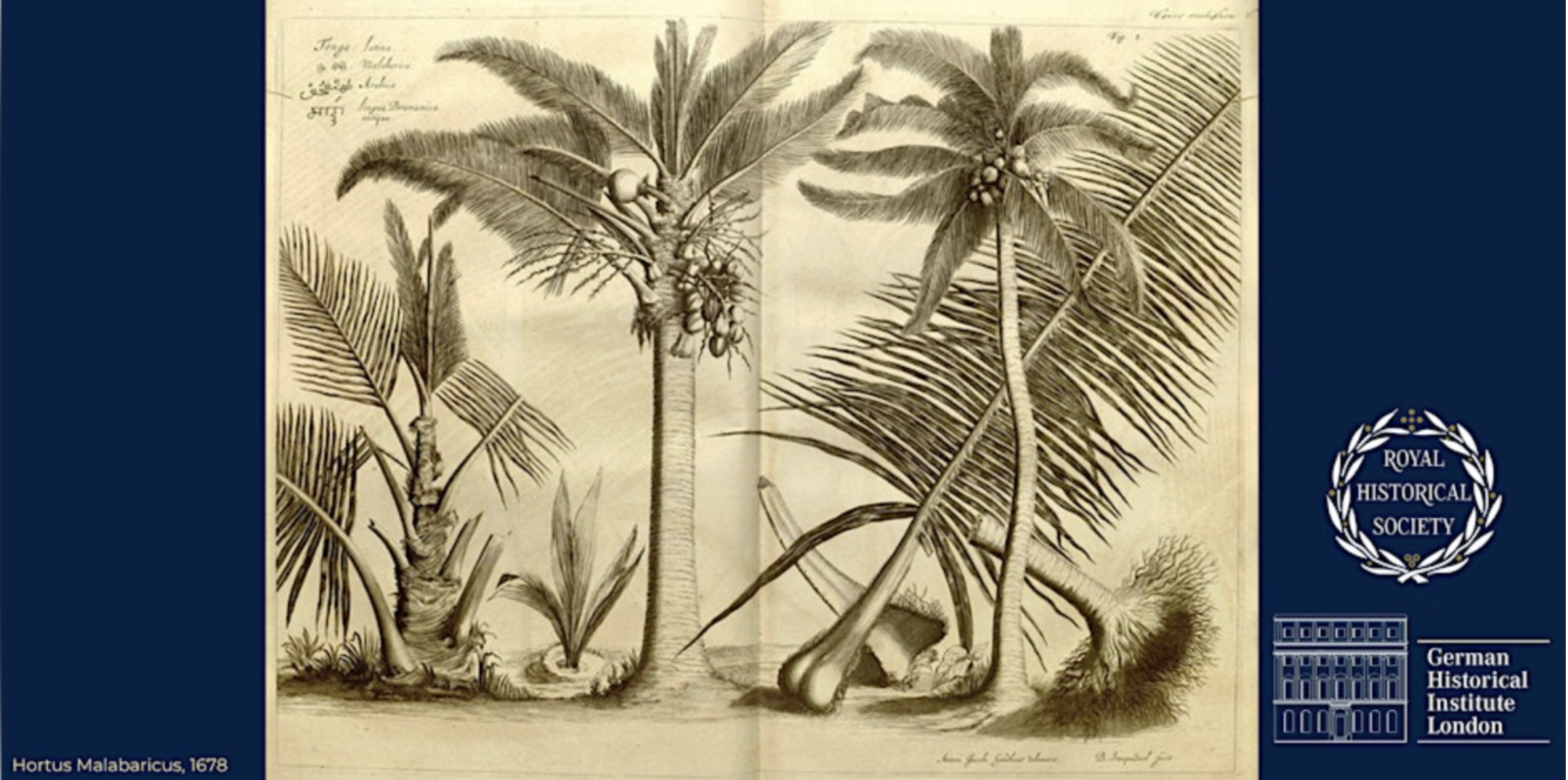
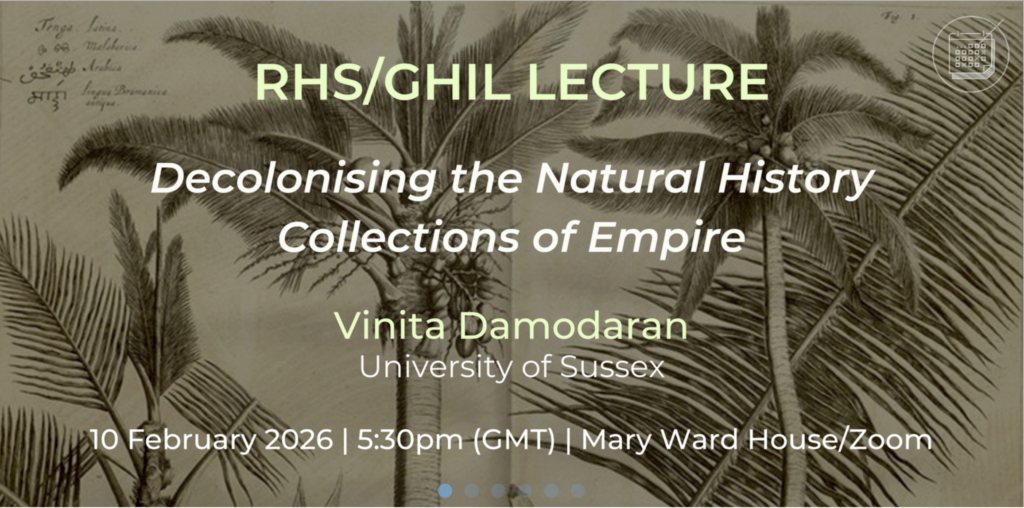
On Tuesday 10 February, the Society hosts its annual Global History Lecture, in partnership with the German Historical Institute, London. This year we are delighted to welcome Professor Vinita Damodaran (University of Sussex) who will speak on ‘Decolonising the Natural History Collections of Empire’.

This year’s lecture takes place at 5.30pm, Tuesday 10 February, at Mary Ward House, 5-7 Tavistock Place, London, WC1H 9SN. Booking for in-person and online attendance is now available. The lecture will be followed by a drinks reception for attendees at Mary Ward House. All are very welcome to attend.

Vinita’s lecture, with a focus on India, explores an important archive of knowledge of the natural world, collected and organised in the context of the empire, in the light of recent historiography on botany and empire. It highlights the importance of creating an inventory and digitally repatriating botanical specimens held primarily in British institutions, and highlights efforts for cultural remediation.

The lecture will examine neglected literature and networks in the imperial scientific network, which were crucial to what was a prodigious scientific renaissance in natural history and environmental understanding in the imperial context from the seventeenth to the nineteenth century.

The 2026 lecture is the third in the RHS / GHIL partnership which began in 2024, with previous lectures by Roland Wenzlhuemer (LMU Munich) and Clare Armstrong (University of Leicester).


Royal Historical Society lectures for early 2026

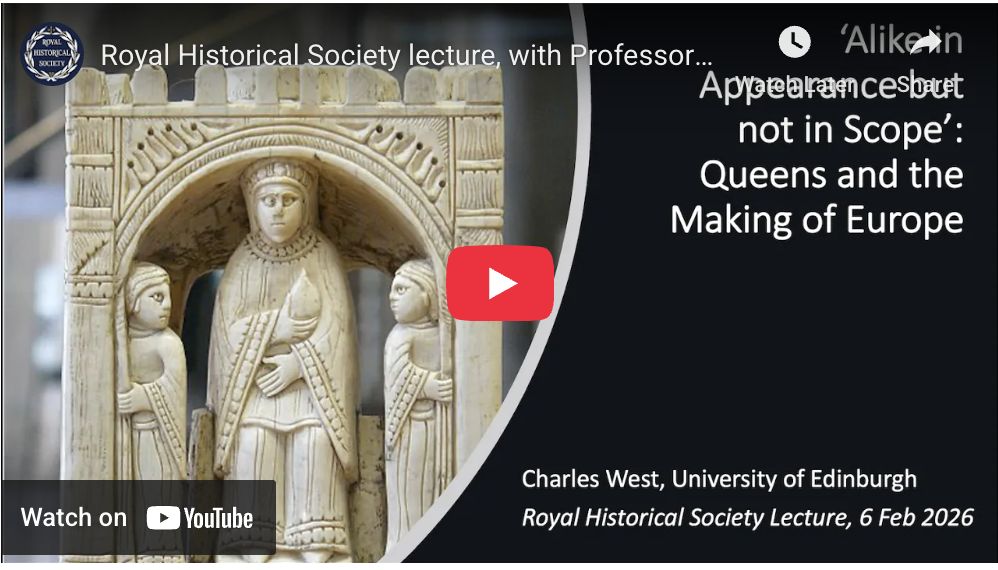
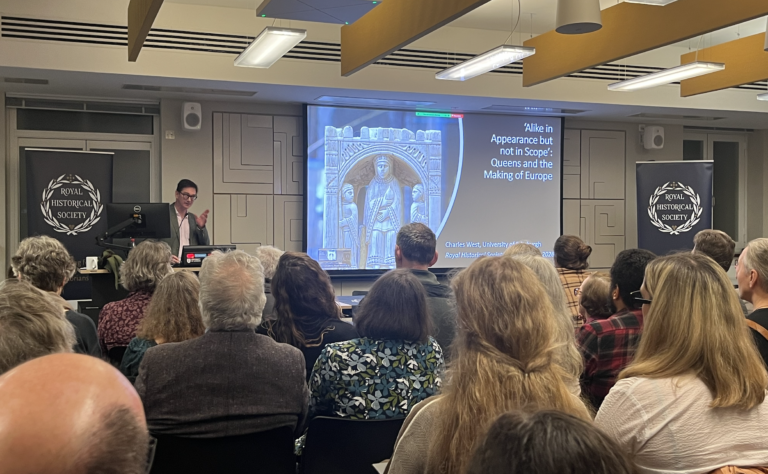
The Royal Historical Society begins its 2026 programme of lectures on Friday 6 February when Professor Charles West (University of Edinburgh) will speak on ‘”Alike in Appearance but not in Scope”: Queens and the Making of Medieval Europe’.

Whereas medieval kings tended to rule in the same place they were born, queens were routinely foreigners within their own realm.

Charles’s lecture starts from this simple observation to reconsider the position of queens in the ‘making’ of post-Carolingian Europe, alongside that of the knights and clerics on whom historical attention has often focused. Through a set of case studies, the lecture looks at the role played by queens as cultural ambassadors in creating, both deliberately and unwittingly, a human network that transcended political borders.

In-person and online booking for this lecture, which takes place at the Institute of Historical Research, Senate House, London, is now available.


On Tuesday 10 February the Society partners with the German Historical Institute, London, to host its 2026 Global History Lecture. Our speaker is Professor Vinita Damodaran (University of Sussex) whose subject is: ‘Decolonising the Natural History Collections of Empire’.

Vinita’s lecture, with a focus on India, seeks to understand this important archive of knowledge of the natural world collected and organised in the context of the empire in the light of recent historiography on botany and empire. It highlights the importance of creating an inventory and digitally repatriating botanical specimens held primarily in British institutions, and highlights efforts for cultural remediation.

The lecture will examine neglected literature and networks in the imperial scientific network, which were crucial to what was a prodigious scientific renaissance in natural history and environmental understanding in the imperial context from the seventeenth to the nineteenth century.

In-person and online booking for this lecture, which takes place at Mary Ward House, London, is now available.


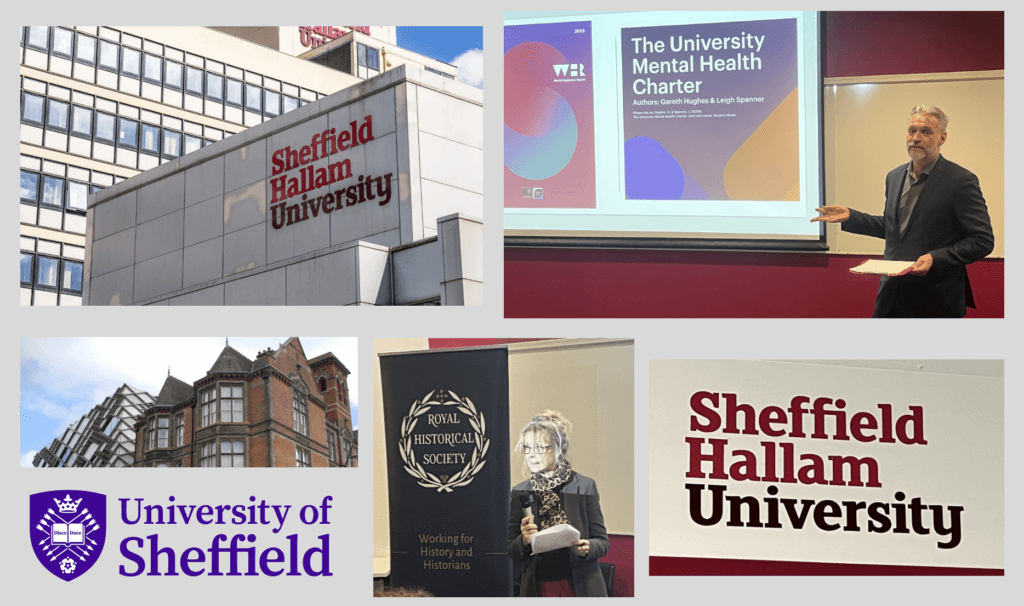
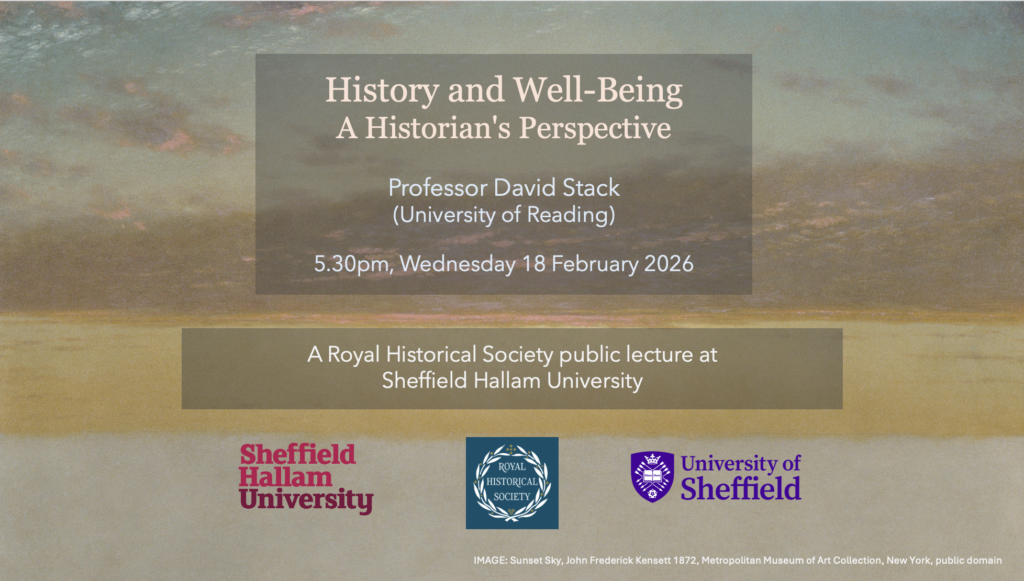
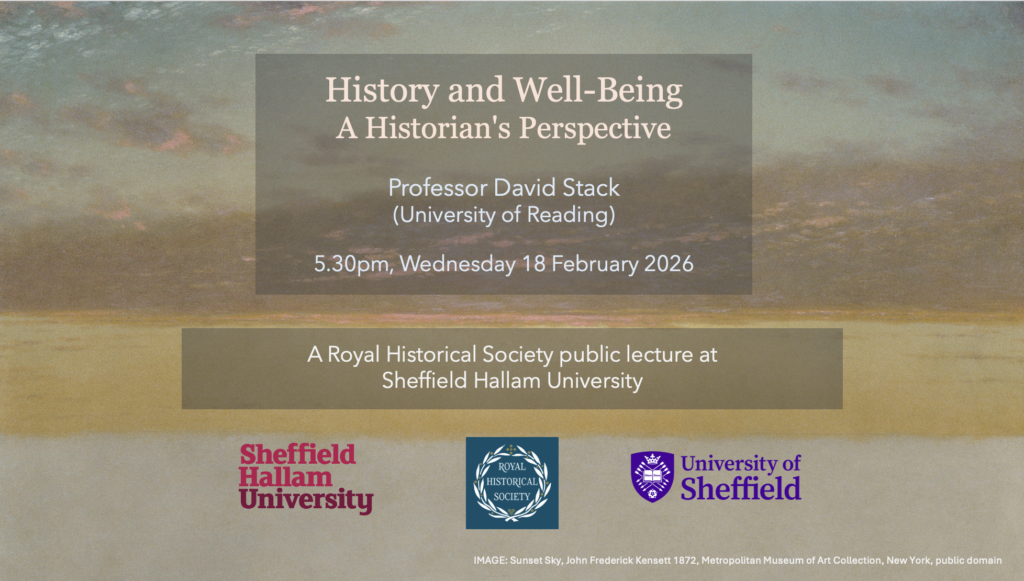
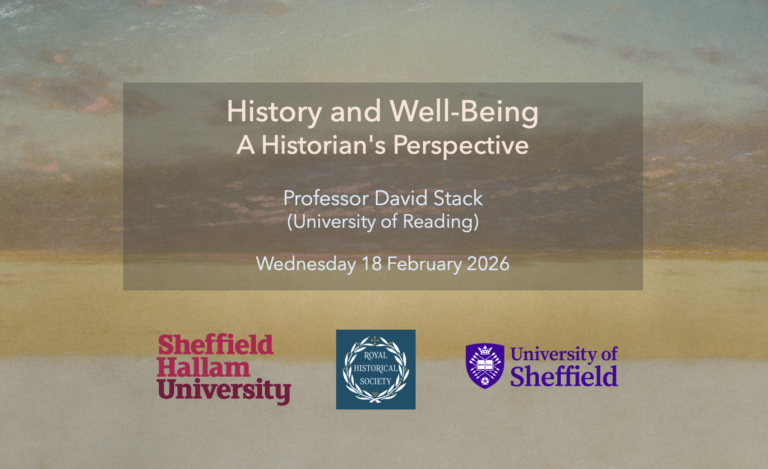
On Wednesday 18 February, the Society hosts the first of its 2026 Visits to historians in universities across the UK. February’s visit, to Sheffield Hallam University and the University of Sheffield, includes a public lecture by Professor David Stack (University of Reading) on ‘Well-being: a Historian’s Perspective’.

David’s lecture considers how historians might engage with contemporary discussions of well-being? What does history have to tell us about the term and its use? Does the study of history contribute to or detract from well-being?

This lecture argues that history can and should make a unique contribution, both to the concept and the practice of well-being. The study of history can deepen our understanding of the structural forces that shape well-being, and, by self-consciously integrating a well-being agenda into our research and teaching, we can simultaneously enhance the well-being of ourselves and our students and demonstrate the relevance of history to one of the most important public policy debates of our time.

This public lecture is part of the Society’s visit to historians at Sheffield Hallam University and the University of Sheffield.

In-person booking for this lecture, which takes place at Sheffield Hallam, is now available.


Other Royal Historical Society lectures to be held later in 2026 include:

  • ‘The Haunting at the Rectory: Ghost Stories and Women’s Lives in Early Modern England’, with Professor Sasha Handley (University of Manchester), on Friday 1 May 2026, at the University of Warwick
  • ‘The Last Voyage of the Santiago: A Ship and its World in the Age of Revolution’, with Professor Rebecca Earle FBA (University of Warwick), on Wednesday 1 July 2026
  • ‘In All Our Footsteps: Rights of Way and Access to the Land in England and Wales since 1949’, with Professor Glen O’Hara (Oxford Brookes University), on Friday 25 September 2026
  • ‘From Cabaret Star to Gaullist Spy: Josephine Baker’s Secret War’, with Professor Hanna Diamond (Cardiff University), on Friday 27 November 2026

For more on these and other Royal Historical Society events in 2026, please see here.


HEADER IMAGE: Surrey Institution, plate 81 (detail) from ‘Microcosm of London’: various artists/makers, 1809, Metropolitan Museum of Art, New York, public domain.


Society visits historians at the London School of Hygiene and Tropical Medicine and UCL Institute of Education

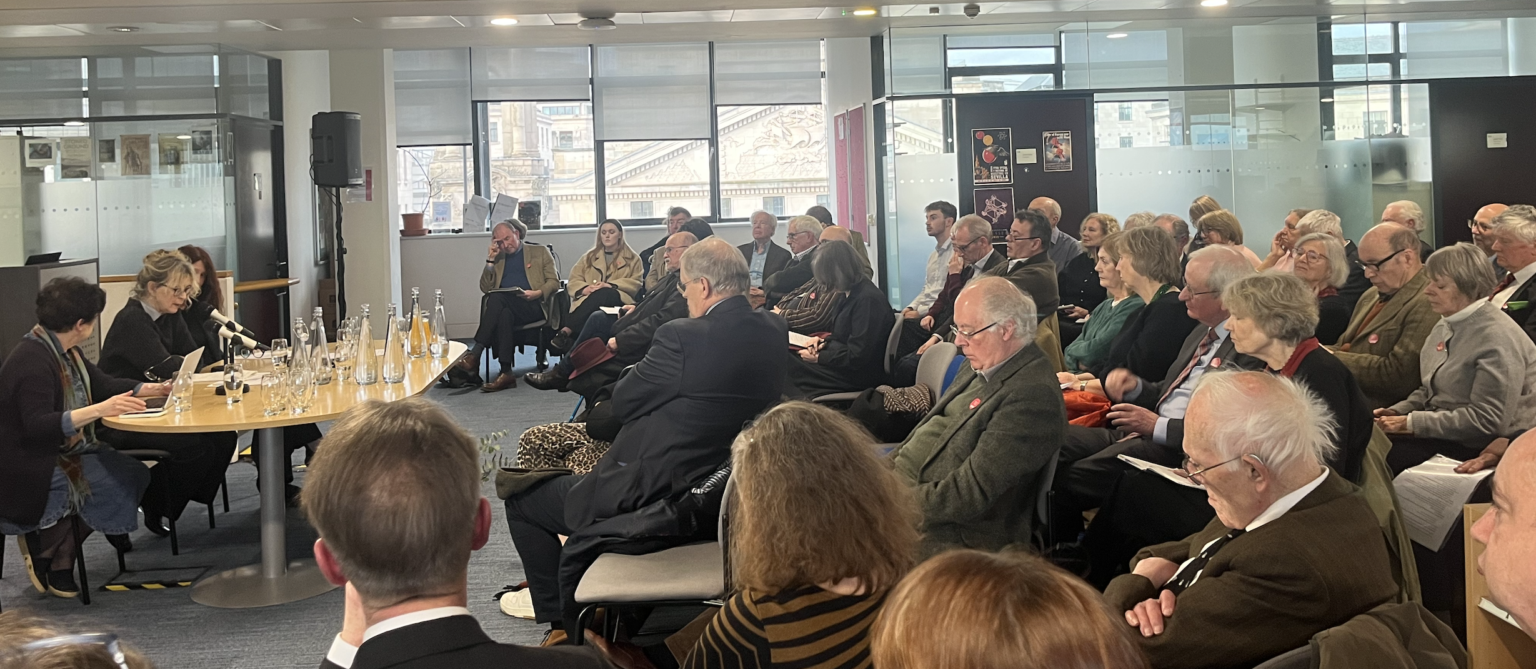
On 10 December, members of the Society’s Council visited historians at the London School of Hygiene and Tropical Medicine and the UCL Institute of Education. This joint visit was an opportunity to learn more about historical studies across both institutions; to discuss shared priorities and concerns; and to consider how the Society can best support the work of historians working in non-History departments.

Our focus for the visit was the experience of working as a historian outside ‘traditional’ history departments. Historians at the IoE and LSHTM work as groups within broader faculties of education, public health and demography. They bring extensive experience of the opportunities and challenges of researching and teaching across and between disciplines, and with colleagues and students with little or no historical training. This is an increasingly common situation for many historians as universities reshape and merge departments and faculties.

Panel sessions considered working in interdisciplinary environments with reference to research, teaching and career development. Contributions highlighted the many intellectual and professional benefits of working collaboratively in fields such as public health and teacher education; the applied policy implications of working with non-historians; and the need (for current of future generations of academic historians) to see ‘history beyond the History department’ as a career path equal to that of colleagues in more traditional structures. A closing session considered how the Royal Historical Society may best identify and support historians across the HE sector, and what those working in non-History departments can offer their fellow historians.

The day concluded with a public lecture given by our guest speaker, Dr Heather Ellis, from the School of Education, University of Sheffield.

Heather’s lecture — ‘Hunger, Health and Hope: A History of School Meals in Britain’ — drew on her ESRC and AHRC-funded project The School Meals Service: Past, Present and Future, to explore how policy, practice, and lived experience have shaped school dining across the twentieth and early twenty-first centuries. With reference to new oral histories, archival evidence, and ethnographic studies in contemporary schools, the lecture highlighted the emotional and sensory dimensions of mealtimes as well as their wider social and cultural meanings.

As Heather argued, schools meals are integral not adjunct to the experience of education. Their study opens raises questions of inequality, poverty, community, and the politics of care. By tracing the past and present of school food, the lecture showed how historical perspectives can illuminate contemporary debates about fairness, health, and childhood in Britain.

Our great thanks to Heather for her excellent lecture, and to Professor Mark Freeman (UCL, IoE) and Dr Janet Weston (LSHTM) for organising the visit and their welcome.


Royal Historical Society visits in 2026

The Society’s next visit is to historians at Sheffield Hallam University and the University of Sheffield, on 18 February 2026. This will include a public lecture by Professor David Stack (University of Reading) on ‘Well-being: a Historian’s Perspective’.

Visits later in 2026 includes those to historians at the universities of Aberystwyth (May), Strathclyde (October) and the West of England / Bristol (December).


Pitch my Project: an opportunity for early career historians to present their work at the Chalke History Festival 2026

Have you ever wanted to share your research with a wide audience? Would you like to gain experience in public speaking, and be supported to develop imaginative ways to communicate your research to the general public?

The Royal Historical Society, Institute of Historical Research and Chalke History Festival are pleased to announce an opportunity for early career historians* to talk about their research in the ‘Chalke Introduces’ programme at the Chalke History Festival, 22-28 June 2026.

This new initiative is designed to provide opportunities for colleagues to develop public speaking skills and reach a wider audience for their research. By doing so, participants strengthen the large and enthusiastic audience for history, and illustrate the strong and vital links between historical research and more popular histories.

Applications may be made, by the closing date, via the applications portal of the Royal Historical Society.


About the Chalke History Festival

From very humble beginnings in 2011, Chalke has grown into the largest multi-format history festival in the UK and Europe, with more than 25,000 people through the gates in 2025. With so much change and upheaval around the world, history has rarely been more important and the programme for 2026 will reflect this, as Chalke brings together the most passionate minds in academic historical investigation, as well as the leading figures of contemporary debate to discuss the themes and concerns that dominate our lives. Past speakers include Tracy Borman, Max Hastings, Tom Holland, Bettany Hughes, Anthony Scaramucci and Her Majesty The Queen.

Since 2024 Chalke History festival been developing the ‘Chalke Introduces’ programme, which provides a platform for early career historians.


About ‘Pitch my Project’

Early career researchers in history are invited to submit a short (500 word) proposal for a talk on their research at Chalke History Festival.  The talk should be designed to be of interest to a wide general audience.

Finalists will be invited to give a short talk to a small audience of judges, IHR Fellows and guests at the Institute of Historical Research, London at 5.30pm on Friday 20 March 2026. A presentation over Zoom can be arranged if in-person attendance is not possible. All finalists will be offered two free tickets to the Chalke History Festival 2026.

Up to two winners will be invited to speak in the ‘Chalke Introduces’ programme of new research at the Festival, and will receive advice and guidance on how to best present their work for a general audience.


How to apply

Please submit the following by 5pm on Friday 6 February 2026:

  • One page CV
  • Title and 500-word (maximum) abstract for your proposed talk

Applications should be submitted via the applications portal of the Royal Historical Society.


Who can apply

  • *Early career historians whose PhD viva was held between December 2020 and December 2025.
  • Eligibility is limited to those whose PhD was in history, and applicants whose PhD was interdisciplinary but with a demonstrated historical component which will be the focus of the proposed talk.
  • Applicants can be graduates of universities within or outside the United Kingdom and Republic of Ireland, but must be resident in the United Kingdom in 2025-26.
  • A limited number of small bursaries will be available to support travel expenses for those invited to attend the event at the Institute of Historical Research on 20 March 2026.
  • Candidates chosen to speak at Chalke History Festival 2026 will have their travel expenses paid.

HEADER IMAGE: ‘The Tanabata Festival’ (detail), from the series ‘One Hundred Famous Views of Edo’, Utagawa Hiroshige,  Japanese, 1857, Metropolitan Museum of Art, New York, public domain.


Society invites applications to join new-look ‘Transactions’ editorial board

The Royal Historical Society seeks to appoint new members to the editorial board of its academic journal, Transactions of the Royal Historical Society, published by Cambridge University Press.

These new members will form part of a new-look single editorial board comprising Fellows of the Society who practice history in the UK and worldwide. The Society seeks to make up to eight appointments in this call; a similar call is expected to be made in December 2026.

This new-look Board will comprise RHS Fellows who reflect the breadth of historical interests and backgrounds within the Society and the wider profession, including gender, race, and career stage. Fellows who are precariously employed or working outside higher education are especially encouraged to apply. 

Applicants must be current Fellows of the Royal Historical Society.

Further details of the role and how to submit an application are available here.

The Society welcomes applications from Fellows working across a wide range range of institutions, disciplines, and professional backgrounds. This includes Fellows who work outside higher education; for example, in sectors such as archives and heritage, and those who work independently and are not affiliated to education, or similar, institutions.

New members of the Editorial Board will work alongside the journal’s co-editors, Dr Jan Machielsen (Cardiff University) and Professor Paul Readman (King’s College London). Appointments will be made jointly by the Society and the Editors. 

The new appointments will take effect from 1 March 2026 or as soon as possible thereafter. After an initial probationary period, the appointment will run for a minimum of two years (to March 2028) with the option to extend for a further two years (March 2030).

Applications may be made via the Society’s Applications Platform before the closing date of 11:59PM, Friday 6 February 2026.

Fellows of the Society who wish to discuss the board roles in advance of an application may contact the journal’s co-editors at [email protected].


About the journal

Transactions of the Royal Historical Society is the flagship journal of the Royal Historical Society (RHS).

Transactions is a generalist journal, including historical content on a wide range of subjects, chronologies and geographies from historians at all career stages and backgrounds. In addition to traditional 10,000-12,000 word research articles, Transactions also welcomes shorter, innovative comment articles on topics of historical approaches, practice and debate.

These commentaries appear in the ‘Common Room’ section of the journal, launched in 2023. From 2024, all articles accepted for publication in Transactions automatically appear Open Access, with no charge to the author, ensuring the widest possible circulation and readership for new work.

The journal’s editorial team provides prompt responses and peer review. Articles are published with Cambridge University Press, online via CUP’s FirstView, and in an annual online and print edition, of the which the most recent is published in December 2025.


Society elects 234 new Fellows, Associate Fellows, Members and Postgraduate Members

At its latest meeting on 21 November 2025, the RHS Council elected 58 Fellows, 30 Associate Fellows, 51 Members and 95 Postgraduate Members, a total of 234 people newly associated with the Society, from today.

The majority of the new Fellows hold academic appointments at universities, specialising in a wide range of fields; but also include curators, librarians, heritage specialists, independent researchers and writers. The Society is an international community of historians and our latest intake includes Fellows from ten countries: Finland, France, Ireland, Israel, Hong Kong, New Zealand, Poland, Spain, the United Kingdom, and the United States.

The new Associate Fellows include not only early career historians in higher education but also historians with professional and private research interests drawn from heritage, learned societies, libraries and archives, teaching, and public and community history.

The new Members have a similarly wide range of historical interests, and include individuals working in universities, culture and heritage, education, the civil service and broadcasting – together with independent and community historians and genealogists.

Our new Postgraduate Members are studying for higher degrees in history, or related subjects, at 44 different universities in the UK, Germany, Hungary, Jamaica, the Netherlands, Poland, Spain, Ukraine and the United States.

All those newly elected to the Fellowship and Membership bring a valuable range of expertise and experience to the Society.


New Fellows and Members are elected at regular intervals through the year. The current application rounds are open and run to 15 December 2025 and 9 March 2026.

Those interested in applying to join the Society (as a Fellow, Associate Fellow, Member or Postgraduate Member) should consult the Join Us pages of the RHS website. Full details of the benefits of Fellowship and Membership are available in the Society’s new Guide for Members.


New Fellows, elected November 2025

  • Peter Auger
  • Melanie Backe-Hansen
  • Poonam Bala
  • Gad Barnea
  • Richard Baxell
  • John Bennett
  • Stephen Bowman
  • Leanne Calvert
  • Alessio Maria Camarda Signorino
  • Erica Canela
  • Esther Chadwick
  • Adam Claasen
  • Meaghan Clarke
  • Joseph Cochran
  • Philip Constable
  • Camillia Cowling
  • Sarah Crook
  • Nick Cumming
  • Angela Davis
  • Johannes Wilfried Dillinger
  • Callum Easton
  • Joanne Edge
  • Daniel Frost
  • Natalee Garrett
  • George Gilbert
  • George Gosling
  • Scott Hames
  • Hannah Holtschneider
  • Xuelei Huang
  • Laura Incollingo
  • Donna Jackson
  • Sadie Jarrett
  • Anthony Michael Kreis
  • ka Chun Lin
  • Sara Lodge
  • Robert Mayhew
  • Gerard McCann
  • Ben Mechen
  • Darren Middleton
  • Ian Miller
  • Joseph Mujere
  • Kate Murphy
  • Kevin Noles
  • Ana María Otero-Cleves
  • Paris Papamichos Chronakis
  • Roger Pearce
  • Vincent Roy-Di Piazza
  • Helen Rutherford
  • Jenny Shaw
  • Lisa Smith
  • Marcin Starzyński
  • David Turner
  • Sean Vanatta
  • Annabel Venning
  • Emily Vine
  • Nicola Whyte
  • Brendan Wolfe
  • Matthew Woolgar

New Associate Fellows, elected November 2025

  • Mark Allen
  • Robyn Atcheson
  • Emma Bastin
  • Kathryn Bruce
  • Wilson Chan
  • Adebusola Dada
  • Susie Deedigan
  • Lucie Bea Dutton
  • Erwin Erhardt, III
  • Uziel González-Aliaga
  • Lorraine Grimes
  • Haley Guepet
  • Rebekah Hodgkinson
  • Musa Igrek
  • Andrew Lewis
  • Jacinta Mallon
  • Michael McLaughlin
  • Yoko Onodera
  • Piotr Potocki
  • Barney Rowe
  • Diki Sherpa
  • Monja Stahlberger
  • Angela Wells
  • Bethan Winter
  • Malika Zehni
  • Pauline Zerla

New Members, elected November 2025

  • The Prince Andrew Adé yí miká Adégbilé
  • Martin Belgrove
  • Lily Bentley
  • Swapnil Bhagat
  • Ethan Bradman
  • David Brown
  • Ken Checinski
  • Henry Chorley
  • Benjamin Davidi
  • Chinonso Ezenwe
  • Richard Farndale
  • Ben Field
  • Giovanni Maria Fiorilla di Santa Croce
  • Simon Flamia
  • Isabella Flynn
  • Fadel Hodroje
  • Alison Hunt
  • Ava Jones
  • Emma Latham
  • Harold Law
  • Jo Levitt
  • Tracey Loke Hassell
  • Crawford Macdonald
  • Ariane Mak
  • Tom Mckellar-Smythe
  • Marco Montaña
  • Stuart Morris
  • Justin Kennedy Muoghara
  • Attila Nagy
  • Mark Otiende
  • Renu Pant
  • Caroline Petherick
  • Jack Pilcher
  • Scott Place
  • Sidney Pycroft
  • Joseph Rawlings
  • David Regan
  • Robert Robinson
  • Niq Ruud
  • Delzar Sadiq
  • Anita Sethi
  • Amie Sillito
  • Susan Soyinka
  • Peter Trenbath
  • Heather Tweed
  • Emmanuel Were
  • Orestes Yatskuliak

New Postgraduate Members, elected November 2025

  • Harun Ali
  • Mathew Ayodele
  • Joshua Baker-Cox
  • Darcie Benoit
  • Nico Blackstock
  • Avonlea Bowthorpe
  • Juliette Bretan
  • Debra Brock
  • Katie Burke
  • Andrew Burns
  • Andrew Byrne
  • Rose Cameron
  • Lesley Carter
  • Emilia Castelao
  • Emily Chung
  • Mara-Elena Ciuntu
  • Kevin Cleary
  • Shantelle Clement
  • Lauren Cole
  • John Concagh
  • Mia Condron Asquith
  • Amy Cottrill
  • Kate Cross
  • Sujato Datta
  • Catherine Dehaut
  • Caroline Devonport
  • Joseph DiDomenico
  • Simone Edgar Holmes
  • Bill Edmonds
  • Jenny Folsom
  • Frederick Fossey-Warren
  • Christine Gerwin
  • William Gordon
  • Ross Hamilton
  • Ryuya Hashiguchi
  • Rebecca Hawkins
  • Karl Hector
  • David Higgins
  • Ellis Hinton
  • Andrii Hrebinnyk
  • Sebastian Hurtado
  • Cian Ireland
  • Mark Jamieson
  • Nicola Johnson
  • Milly Jonas
  • Mark Jones
  • Maarten Jonker
  • Howon Jung
  • Nadzieja Kolodziejski
  • Joanna Lastun
  • Marcin Lewicki
  • Rhys Lewis
  • William Lewis
  • Yuang Marcus Liu
  • Daniel Lucas
  • Ila Manish
  • William Matthews
  • Alfonso Menanno UE
  • Amy Meyer
  • Madeleine Miller
  • Elaine Mitchell
  • Iago Mora Arcas
  • Shelby Neuhauser
  • Claire Ó Nualláin
  • Aaron Oliver
  • Petrina Oliver
  • Tina Onur
  • Taylan Paksoy
  • James Parker
  • Frédéric Perron-Welch
  • Roslyn Potter
  • Guillaume Proffit
  • James Richardson
  • Rajosmita Roy
  • Asmita Sarkar
  • John Schaefer
  • Tanishka Sethi
  • Saundrie Shaw
  • Jane Skelding
  • Katie Southward
  • Pauline Standley
  • Anna Ulrika Stark
  • Lei Tang
  • Plamen Todorov
  • Adefolatomiwa Toye
  • Rae Tunstall
  • Elizabeth Turner
  • Jackson van Uden
  • Luke Walker
  • Tianwei Wang
  • Ireland Wright
  • Penny Young
  • Arif Zaman
  • Qianyi Zhang
  • Yifei Zhang


HEADER IMAGE: Hendrick Avercamp, c.1608, ‘Winter Landscape with Ice Skaters’, Rijksmuseum, public domain


Recordings available of the Society’s 2025 Anniversary Lecture, with Professor Jane Ohlmeyer

On 21 November, the Society was delighted to welcome Professor Jane Ohlmeyer to give the 2025 RHS Anniversary Lecture: ‘Visible | Invisible: Voices of Women in Early Modern Ireland’.

Recordings of Jane’s lecture are now available.

  • Listen to an audio version of this lecture


  • Watch this lecture


Jane’s lecture introduced her current five-year research project, VOICES, which brings together historians and computer scientists to recover the lives of early modern women in Ireland. VOICES uses transcription software and Generative AI to capture data from deposition, burial and other records to generate a ‘knowledge graph’ of Irish women, their networks and experiences, between c.1550 and 1700.

Jane’s lecture provided insights into the methodologies of the VOICES project, the rewards and challenges of using Artificial Intelligence at scale, and some early findings from the project for recovering and redefining the place of women in early modern Ireland.

Jane Ohlmeyer is Erasmus Smith’s Professor of Modern History (1762) at Trinity College Dublin and an expert on the history of early modern Ireland and empire. Jane is the author or editor of numerous articles and 14 books, of which the latest is Making Empire: Ireland, Imperialism and the Early Modern World (Oxford, 2023), based on the 2021 Ford Lectures at the University of Oxford. In 2023 Jane was awarded the Royal Irish Academy Gold Medal in the Humanities. In 2023, she received an Advanced ERC for VOICES, a project on the lived experiences of women in early modern Ireland.

Our great thanks to Jane for her lecture and to all those who joined us in person and online.

The Society’s Anniversary Lecture marks the anniversary of the Society’s foundation on 21 November 1868. The lecture was preceded by the Society’s Anniversary Meeting (AGM) presented by the President, Professor Lucy Noakes.


‘A Collector Collected’: latest volume published in the Society’s Camden series of primary editions

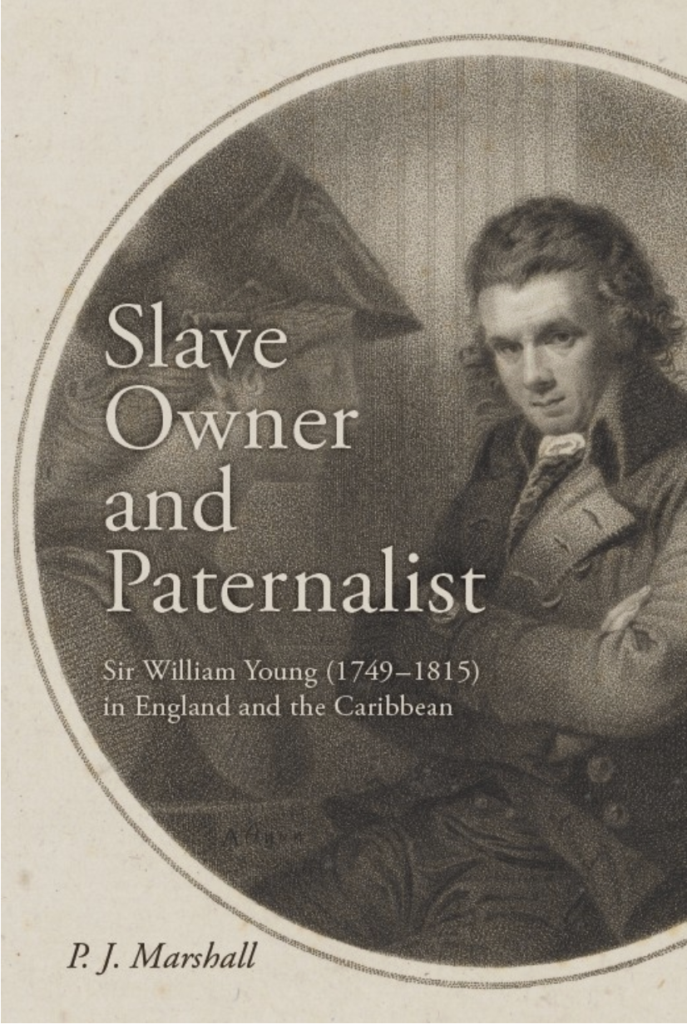
The latest volume in the Society’s Camden Series of primary editions is A Collector Collected. The Journals of William Upcott, 1803-1823, edited by Mark Philp, Aysuda Akan and Curtis Leung.


William Upcott (1779–1845) rose from humble origins to become a major collector of coins, prints, drawings, and, above all, autographs.

His journals, from 1803 to 1809, chronicle his time as a lowly bookseller’s assistant in London and then as an assistant at the London Institution. They offer a detailed, non-elite account of a London life, interspersed with forays into the provinces to visit relatives in Oxfordshire and Northamptonshire, and to pursue his trade as a cataloguer and organiser of people’s collections, most notably in Shugborough Hall, Staffordshire.

His later ‘Tour of the Peak’ in 1823, evidences his growing expertise and his open acceptance by his fellow enthusiasts.

Upcott’s diaries are lively and engaging narratives of his life and activities in a world that he increasingly made his own, overcoming his deficiencies to become an accomplished bibliophile and collector.

A Collector Collected: The Journals of William Upcott, 1803-1823 is now available online and in print Cambridge University Press. Fellows and Members of the Society may order print copies at the reduced price of £16 per volume. To order a copy please contact: [email protected], marking your email ‘Camden’.

To accompany publication of this new volume, Mark, Aysuda and Curtis have also written about the life and work of William Upcott on the Society’s blog.


About the Camden Series

The Society publishes new volumes in the Camden Series each year.

Two further volumes were published in 2025: The Papers of Admiral George Grey, edited by Michael Taylor (June 2025) and The Holograph Letters of Margaret Tudor, Queen of Scots (1489-1541), edited by Helen Newsome-Chandler (August 2025).

The Royal Historical Society’s Camden Series is one of the most prestigious and important collections of primary source material relating to British History, including the British empire and Britons’ influence overseas.

The Society (and its predecessor, the Camden Society) has since 1838 published scholarly editions of sources — making important, previously unpublished, texts available to researchers. Each volume is edited by a specialist historian who provides an expert introduction and commentary.

Today the Society publishes two new Camden volumes each year in association with Cambridge University Press. The complete Camden Series now comprises over 390 volumes of primary source material, ranging from the early medieval to late-twentieth century Britain.


Society launches call for new Applied History Fellowships, with the Institute of Historical Research and DC Thomson

In November 2025, the Society joins with partners the Institute of Historical Research (IHR) and publisher DC Thomson to launch a new Applied History Fellowship programme to support recent post-doctorate historians.

This initiative responds to three pressing challenges:

  • the need to build sustainable bridges across different parts of the history community;
  • the deeply challenging academic job market; and
  • the need to advocate for the utility of history beyond the HE sector. The new Applied History Fellowships seek to expand the range of futures open to early career historians and to enhance the applied skills of those who do pursue a university career.

The Fellowships offer a bursary of £12,000 per award for a 6 month period. Fellowships will normally be held between April and September 2026.

Applications for the first round of Applied History Fellowships are now invited between 19 November 2025 and 31 January 2026.

Further information about the programme, with details of how to submit an application, are available from the Institute of Historical Research.


Fellowships will provide financial and practical support for those wishing to develop the wider impact and application of their academic work. The Fellowship provides time to develop publication, impact and engagement profiles. It also facilitates a two-day a week online placement with The Social History Archive (TSHA) so that Fellows can develop skills within a commercial history context.

Successful Fellows will become members of the IHR and be offered a 12-month free Associate Fellowship of the Society, whose Councillors will also provide professional mentoring. Fellows will also be invited to become members of the TSHA editorial board.


Applications invited for the Society’s Centenary PhD Fellowships, 2026-27

Applications are now invited for the Royal Historical Society’s Centenary PhD Fellowships to support postgraduate historians to complete a doctorate. Two Fellowships, of six months each, are offered for the academic year 2026-27. Each Fellowship is worth £8,500 and held in association with the Institute of Historical Research (IHR), University of London. Fellows also receive free membership of the Society for the academic year 2026-27.

The RHS Centenary Fellowships are part of a larger programme of doctoral funding overseen by the IHR, to enable holders to complete a dissertation. Applications are now invited via the Institute’s website before the closing date of 31 January 2026.

RHS Centenary Fellowships are intended as completion awards. They will be awarded to students who are engaged in doctoral research in history (broadly defined) and who will have completed at least three years of full-time or four years of part-time research on their doctoral programme (and not more than four years’ full-time or six years’ part-time) at the beginning of the academic year in which the awards will be held. Adjustments to these timings will be made for North American degrees, which are longer in duration. Fellowships will normally be tenable for six months.

These awards cannot be held in conjunction with any other substantial maintenance grant. Fellows may engage in teaching or other paid work for up to six hours per week.

A condition of the awards is that Fellows will participate actively in the academic life of the Institute. They will be required to attend and present papers at appropriate IHR seminars and to give information and help to fellow scholars working in the same field.

For more on this programme, and how to submit an application by 31 January 2026, please see the IHR page here.