
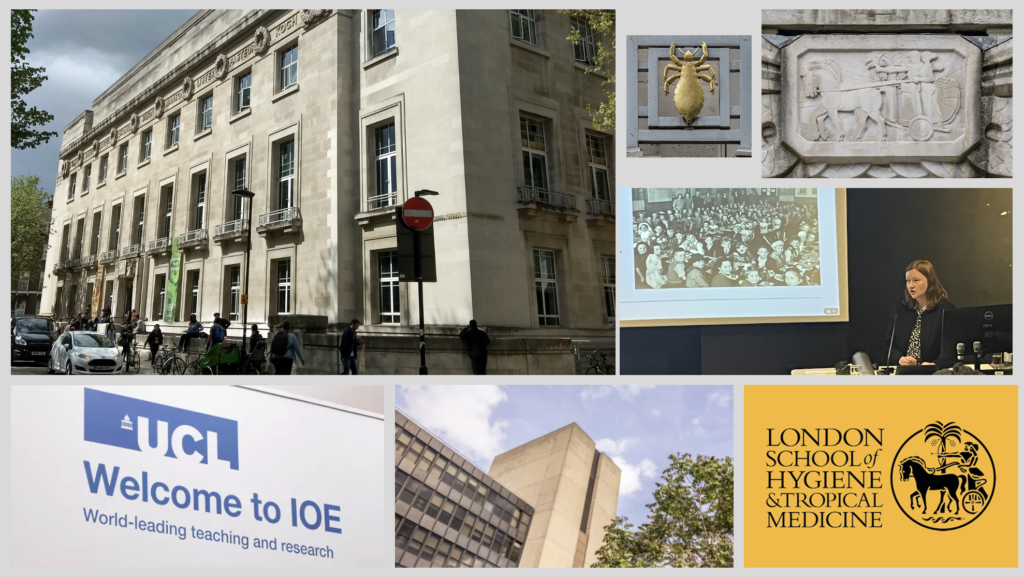
On 10 December, members of the Society’s Council visited historians at the London School of Hygiene and Tropical Medicine and the UCL Institute of Education. This joint visit was an opportunity to learn more about historical studies across both institutions; to discuss shared priorities and concerns; and to consider how the Society can best support the work of historians working in non-History departments.
Our focus for the visit was the experience of working as a historian outside ‘traditional’ history departments. Historians at the IoE and LSHTM work as groups within broader faculties of education, public health and demography. They bring extensive experience of the opportunities and challenges of researching and teaching across and between disciplines, and with colleagues and students with little or no historical training. This is an increasingly common situation for many historians as universities reshape and merge departments and faculties.
Panel sessions considered working in interdisciplinary environments with reference to research, teaching and career development. Contributions highlighted the many intellectual and professional benefits of working collaboratively in fields such as public health and teacher education; the applied policy implications of working with non-historians; and the need (for current of future generations of academic historians) to see ‘history beyond the History department’ as a career path equal to that of colleagues in more traditional structures. A closing session considered how the Royal Historical Society may best identify and support historians across the HE sector, and what those working in non-History departments can offer their fellow historians.
The day concluded with a public lecture given by our guest speaker, Dr Heather Ellis, from the School of Education, University of Sheffield.
Heather’s lecture — ‘Hunger, Health and Hope: A History of School Meals in Britain’ — drew on her ESRC and AHRC-funded project The School Meals Service: Past, Present and Future, to explore how policy, practice, and lived experience have shaped school dining across the twentieth and early twenty-first centuries. With reference to new oral histories, archival evidence, and ethnographic studies in contemporary schools, the lecture highlighted the emotional and sensory dimensions of mealtimes as well as their wider social and cultural meanings.
As Heather argued, schools meals are integral not adjunct to the experience of education. Their study opens raises questions of inequality, poverty, community, and the politics of care. By tracing the past and present of school food, the lecture showed how historical perspectives can illuminate contemporary debates about fairness, health, and childhood in Britain.
Our great thanks to Heather for her excellent lecture, and to Professor Mark Freeman (UCL, IoE) and Dr Janet Weston (LSHTM) for organising the visit and their welcome.
Royal Historical Society visits in 2026
The Society’s next visit is to historians at Sheffield Hallam University and the University of Sheffield, on 18 February 2026. This will include a public lecture by Professor David Stack (University of Reading) on ‘Well-being: a Historian’s Perspective’.
Visits later in 2026 includes those to historians at the universities of Aberystwyth (May), Strathclyde (October) and the West of England / Bristol (December).