
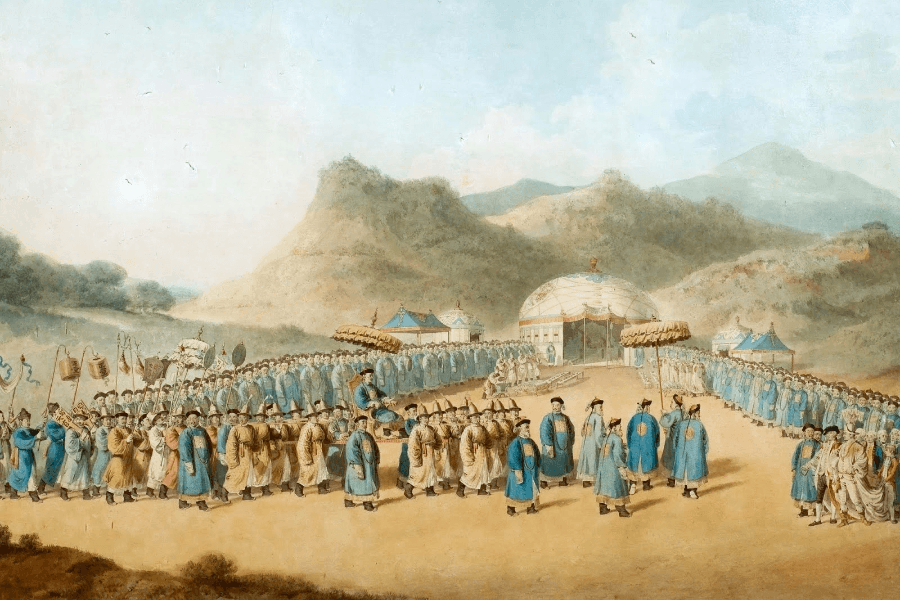
Join us on 16 November at the German Historical Institute London for the final lecture in our series in collaboration with the Fritz Thyssen Foundation given by Jürgen Osterhammel, Distinguished Fellow at the Freiburg Institute for Advanced Studies (FRIAS), on “A Most Peculiar Empire: Imperial and Post-Imperial China at the Confluence of Western and Chinese Knowledge”.
Sign up via the GHIL’s website: https://www.ghil.ac.uk/events/lectures#c4350
The Chinese Empire was established in 221 BCE and lasted until 1911. As a multi-ethnic state of vast territorial extent, it was resuscitated under Communist rule from 1949 onwards, though with the old imperial rhetoric left out. Debates are ongoing about the question of whether China is perhaps the most ambitious and successful quasi-empire that remains in the contemporary world.
From the times of Marco Polo (around 1300), who was the first European eyewitness to report from Peking, the Chinese Empire coloured any European discussion about empire, whether openly or clandestinely. As a compact and usually well-governed continental empire without aggressive maritime designs, China fascinated the European imagination through several historical stages. In the seventeenth and eighteenth centuries, it was described by travellers and non-travelling intellectuals of the European Enlightenment as a model for the rest of the world. In the nineteenth century its fortunes and reputation changed dramatically and it became the epitome of a failed state. In the twentieth century Western observers marvelled at the sources of imperial resilience in a country that had become the victim of Western and Japanese imperialism.
When Sinology emerged as an academic discipline in the early nineteenth century, it virtually became a science of empire. Not surprisingly, Chinese conceptions of empire influenced European perceptions and constructions from the seventeenth century onwards, when Jesuit missionaries started to read and translate Chinese sources and historiography. Hence, Western images of China were never entirely ‘Western’; in various forms they reflected indigenous notions of the Chinese state. On the Chinese side, conceptions of empire, as they emerged in the early twentieth century, reacted against the realities of victimization and reflected the impact of nationalism and Marxist socialism. The new Chinese ‘empire’ has a highly ambivalent relationship to its dynastic predecessor.
Jürgen Osterhammel is a Distinguished Fellow at the Freiburg Institute for Advanced Studies (FRIAS). He was Professor of Modern and Contemporary History at the University of Konstanz until his retirement in 2018. His publications in English include The Transformation of the World: A Global History of the Nineteenth Century (Princeton, 2014); Decolonization: A Short History (co-authored with Jan C. Jansen, Princeton, 2017); Unfabling the East: The Enlightenment’s Encounter with Asia (Princeton, 2018); and Rethinking Global History (co-edited with Stefanie Gänger, Cambridge, 2024). With Akira Iriye, he edited a six-volume History of the World (Cambridge, MA, 2012–2025).