
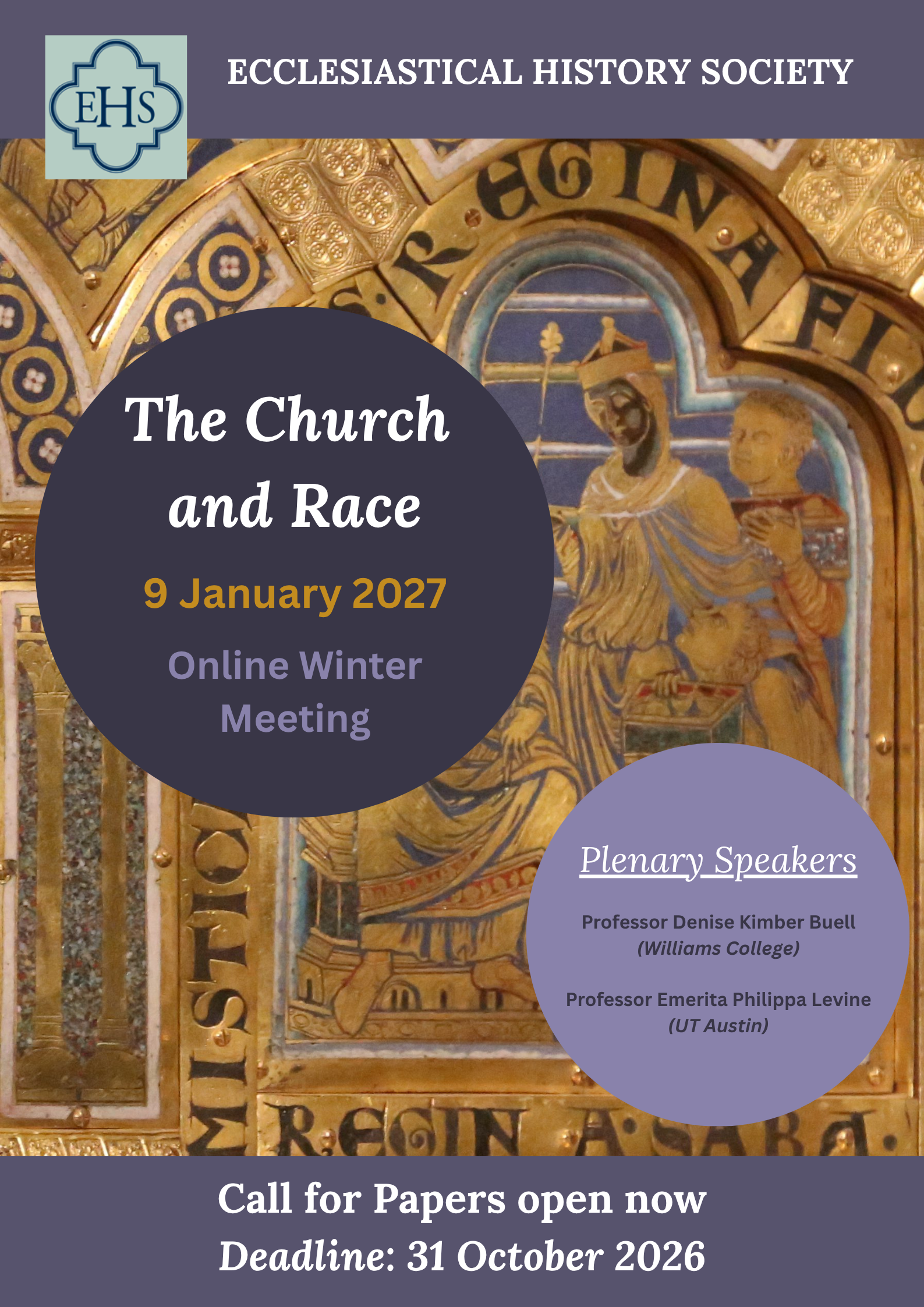
The 2027 EHS Winter Meeting theme will be ‘The Church and Race’, held online on 9 January 2027.
The Call for Papers for this meeting is now open. Please submit your abstracts here by 31 October 2026: [https://ecclesiasticalhistorysociety.com/27wintermeeting/]
In his letter to the Galatians, Paul reminded that community that in Christ – and in His Church – there was no distinction between persons: ‘There is neither Jew nor Greek, there is neither slave nor free, there is neither male nor female; for you are all one in Christ Jesus’. The water of baptism made all believers equal in salvation, yet Christians struggled to believe that all Christians were indeed the same. Wherever the Church’s representatives reached – be it Augustine in sixth-century England, Friar William of Rubruck in thirteenth-century China, Father Marquette in the Great Lakes in the seventeenth century, or Archbishop Selwyn in what was to become New Zealand – they wondered whether people so different in appearance and temperament could become Christians too. And if they could, then what sort of Christian? Might they too aspire to monastic perfection or to episcopal dignity?
Race thinking was a guiding factor not only at Christianity’s ever-expanding borderlands, it was at work in cities where Christians of different origins, languages, and complexions met; it operated on land and at sea, in streets and in marketplaces; it attended the arrival of unfamiliar groups through migration or enslavement, like the African slaves sold in Florence and Lisbon in the later Middle Ages, the people who were soon named ‘gypsies’ in the 15c, the Jews expelled from Iberia in 1492 and who settled in Italy and the Low Countries, the Irish who migrated to the US in the 19c, or the south Asians who provided migrant labour throughout the 19/20c across the British Empire.
All these questions vexed theologians in universities, challenged bishops as they guided their parish clergy, and troubled missionaries at work across the globe. Race-thinking informed intellectual work, pastoral care, and relations between Christians as neighbours and parishioners. Race also inspired visual forms: in the mappae mundi, in the representation of Jews in crucifixion scenes, on frontispieces of books that guided mission, and in figures deemed exotic or virtuous, like the magus Balthasar. The multitude of contexts within which race was imagined and imposed means that perspectives from a variety of disciplines – history, theology, literary and visual expertise – must meet and combine fruitfully to understand processes that produced a great deal of suffering and pain, with a legacy that is always with us. Yet historical exploration also suggests ways in which race and racialisation could be countered, opposed, resisted. All this work is of the greatest interest and consequence. Our Conference will offer an occasion for collective learning, sharing and reflection; the keynote lectures in particular will introduce concepts and methods that facilitate a better understanding of race thinking, the processes of racialisation, as well as racialised lives in Christian societies.
Exploring the past through race is challenging work. For how is one to consider a concept that is so flawed in its conception and yet so ubiquitously used to describe – and according to some, even improve – the world? Race-thinking attempts to arrange humans into hierarchies and so to justify different allocations of rights and resources among them: by skin colour, by ethnicity, by religion. It is an untruth that is none the less a significant historical phenomenon used to justify conquest, mission, enslavement, and genocide. Race-thinking reduces individuals to a single characteristic, and so dehumanises them. The process of racialisation has taken place at most times and in many places, in variations that make it an historical phenomenon that now receives the attention it deserves.
Keynote speakers:
Professor Denise Kimber Buell, Williams College
Professor Emerita Philippa Levine, University of Austin Texas