
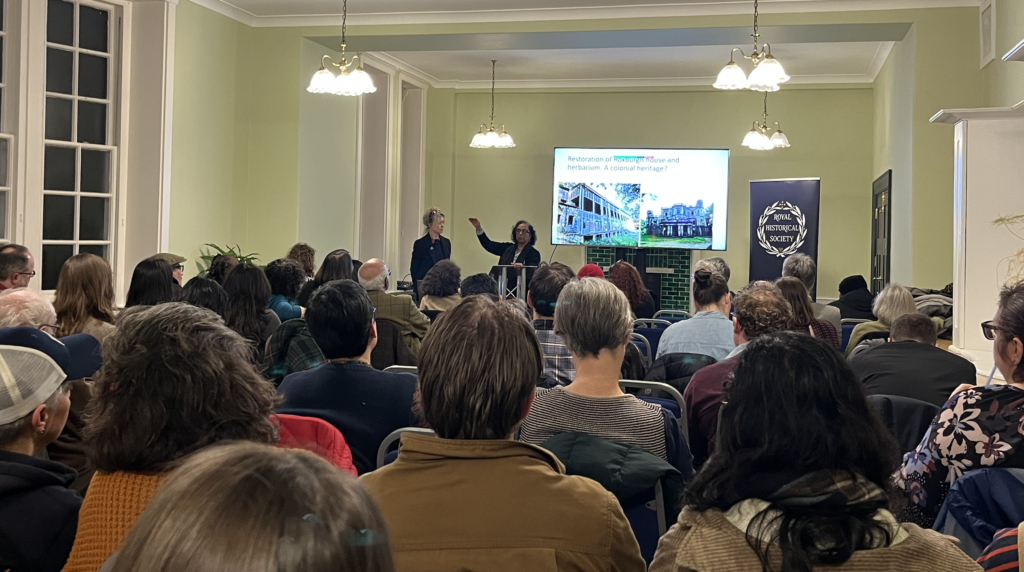
On 10 February the Royal Historical Society co-hosted its annual Global History Lecture with the German Historical Institute, London. The partnership between the Society and GHIL is now in its third year and invites historians working in the UK and Germany to present new global historical research.
This year’s speaker was Professor Vinita Damodaran (University of Sussex) who spoke on ‘Decolonising the Natural History Collections of Empire’.
In this lecture, Vinita focused on the forms and legacies of botanical collecting in India under empire. Her lecture examined neglected indigenous literatures that were crucial to what, in the imperial context, was an early modern scientific renaissance in natural history and environmental understanding.
Vinita’s lecture also framed this forgotten literature on and knowledge of the natural world—one collected and organised in the context of the empire—in the light of recent historiographies on botany and empire. This reclamation and restoration of indigenous Indian studies and classifications of the natural world now includes the digital repatriation of botanical specimens held primarily in British institutions. In addition, the lecture drew attention to current work, undertaken by Vinita, in the field of cultural remediation.
An audio recording of this year’s RHS / GHIL Global History Lecture will be available shortly.
Vinita Damodaran is Professor of South Asian History at the University of Sussex and a specialist in the history of modern India, with particular interests in environmental change, identity and resistance in Eastern India.
Her research ranges from the social and political history of Bihar to the environmental history of South Asia, including using historical records to understand climate change in the Indian Ocean World. At Sussex, Vinita is also director of the university’s Centre for World Environmental History, which partners with UK institutions such as Kew Gardens, and the Met Office as well as universities and research centres in India and Canada.
Our great thanks to Vinita for her fascinating lecture, to all who attended in person and online, and to colleagues at the German Historical Institute, London, for this event partnership.
Our next lecture: Sheffield, 18 February 2026
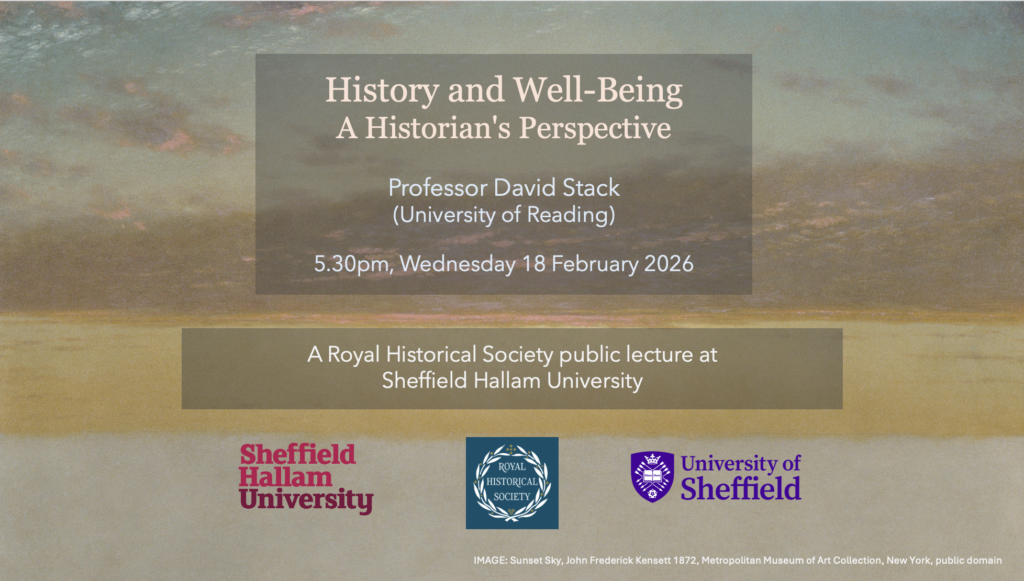
On Wednesday 18 February, the Society hosts the first of its 2026 Visits to historians in universities across the UK. February’s visit, to Sheffield Hallam University and the University of Sheffield, includes a public lecture by Professor David Stack (University of Reading) on ‘Well-being: a Historian’s Perspective’.
David’s lecture considers how historians might engage with contemporary discussions of well-being? What does history have to tell us about the term and its use? Does the study of history contribute to or detract from well-being?
This lecture argues that history can and should make a unique contribution, both to the concept and the practice of well-being. The study of history can deepen our understanding of the structural forces that shape well-being, and, by self-consciously integrating a well-being agenda into our research and teaching, we can simultaneously enhance the well-being of ourselves and our students and demonstrate the relevance of history to one of the most important public policy debates of our time.
This public lecture is part of the Society’s visit to historians at Sheffield Hallam University and the University of Sheffield.
In-person booking for this lecture, which takes place at Sheffield Hallam, is now available.